





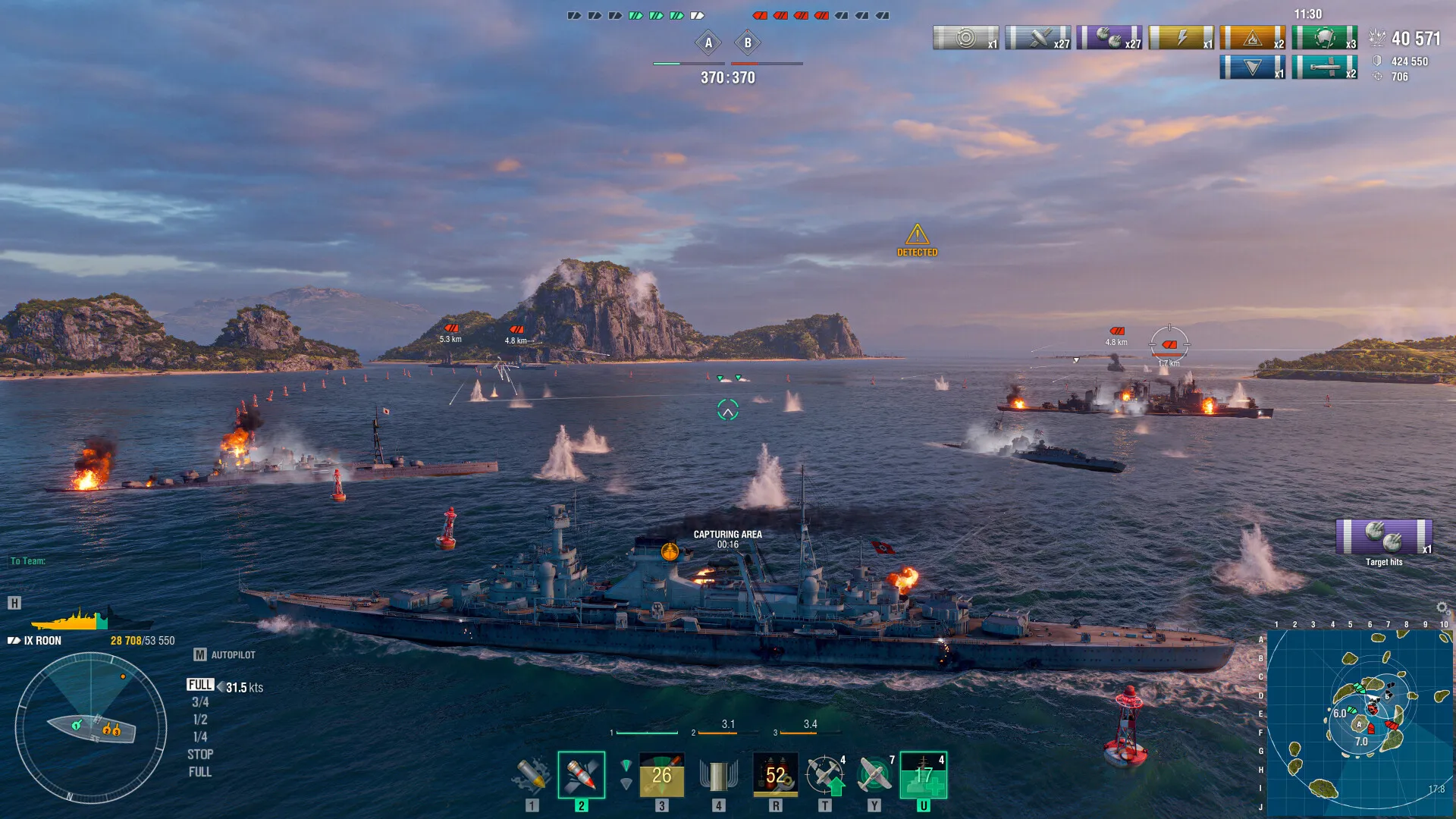
World of Warships looks simple: ships fire shells, ships take damage, one side sinks the other. But beneath the surface lies one of the most complex damage-calculation engines in any modern multiplayer game. The mechanics of armor angling, shell normalization, fuse timers, overmatch, ricochet thresholds, and penetration formulas determine almost every moment of high-level play. And yet most players never fully understand why one shot devastates a target while another seemingly identical shot shatters on impact.
This article explores the exact problem many players face: the invisible layers of logic governing armor angling. Instead of generic tips, this is a complete deep analysis of the internal systems determining whether your shot penetrates, ricochets, overpens, or detonates a citadel. With ten structured sections arranged logically by difficulty and progression, this guide will help you understand naval combat at a level most players never reach.
By the end, you will know not just what to do, but why it works.
The Hidden Foundation of Damage: How Impact Angles Shape Every Shot
World of Warships uses an angle-based penetration model that simulates realistic shell behavior. The game decides the outcome of a shot in milliseconds using several sequential checks: impact angle, armor thickness, overmatch rules, fuse arming, and ricochet thresholds.
New players often assume that raw penetration is all that matters. But each shot first passes through a subtle gate: the angle check. A shell striking at too shallow an angle will not penetrate even if its penetration value is higher than the armor. It will simply bounce. This core principle is why angling your ship is the most powerful defensive move in the game.
Understanding this mechanic is the gateway to mastering naval combat. Every ship’s survivability, from a battleship's massive armor plates to a destroyer’s thin hull, is shaped by angles before anything else.
Why Ricochet Thresholds Dictate the Rhythm of Combat
Every shell type has a built-in ricochet angle. For standard AP shells, there are two critical values:
• auto-bounce angle
• guaranteed penetration angle
If your incoming AP shell hits armor outside these angles, the game does not care about your penetration value. The shell simply deflects.
For example, most AP shells begin to ricochet around 45 degrees and auto-bounce at 60 degrees. This means that the majority of battleship shells will fail to penetrate sharply angled cruisers or other battleships unless the attacker finds a weak point.
When players complain that “my shells did no damage,” the answer is almost always found in this mechanic. What looks like a perfect broadside becomes a bounce simply because the hull is angled a few degrees too steeply.
The ricochet threshold is the quiet architect of battle flow. Every push, retreat, and rotation on the battlefield is shaped by these invisible numbers.
Overmatch: The Rule That Completely Breaks Armor Angling
Overmatch is one of the most feared and misunderstood mechanics in the game. It allows a large-caliber shell to ignore angling entirely and penetrate armor no matter the angle. This is governed by a simple rule:
If a gun’s caliber is 14.3 times larger than the armor thickness, it overmatches.
For example:
• 457 mm guns overmatch 32 mm plating
• 406 mm guns overmatch 28 mm plating
• 380 mm guns overmatch 26 mm plating
A destroyer cannot angle against battleship guns. A cruiser cannot angle against Yamato’s 460 mm guns. And even battleships can be overmatched by larger counterparts.
This creates a strategic landscape where positioning—not just angling—becomes life or death. You cannot rely on geometry when the enemy holds a caliber advantage. Players who learn this mechanic stop blaming “RNG” and start reading the calibers of enemy battleships like a life-saving skill.

Shell Normalization: The Quiet Factor That Decides Close Fights
Normalization refers to how much the game artificially reduces a shell’s impact angle after it hits armor, simulating how a real shell might dig into steel and straighten its path.
Higher-caliber shells normalize more, making them better at penetrating angled targets. Smaller guns, especially cruiser AP, normalize less and therefore struggle against angled battleships.
This creates a unique tactical layer:
• At long range, normalization becomes more important because shells strike at steeper angles.
• At close range, normalization matters less because shells hit flatter surfaces.
Players who understand normalization know exactly when to switch from HE to AP, when to kite away, and when to close distance for maximum lethality.
Why Angling Works Differently for Each Ship Class
Each ship class has a different relationship with armor angling, and mastering this is key to using angle mechanics correctly.
Battleships rely heavily on angling. When angled properly, even massive shells bounce off their belt armor. Their playstyle revolves around presenting maximum effective armor through positioning.
Cruisers depend on angling situationally. Their armor is thinner, so they rely more on not being hit at all. But angling can allow a cruiser to bounce AP from other cruisers or poorly aimed battleship shots.
Destroyers cannot angle effectively against AP from larger guns. Their best defense is evasion and concealment, not armor geometry.
Aircraft carriers have poor armor design and rely on distance, teammates, and map awareness. Angling has almost no effect on their interactions.
Understanding this hierarchy is essential because not all ships can use armor angling in the same way. Survival depends on knowing when angle matters—and when it does not.
The Fusion of Fuse Timers and Armor Layers
AP shells must travel through enough armor to arm their fuses. If they arm too late, they exit the ship and overpen, dealing minimal damage. If they arm too early, they detonate on the outer layer, also causing low damage.
Different ship classes intentionally use multi-layer armor schemes to manipulate fuse timers.
A well-designed cruiser might cause a battleship shell to explode before reaching the citadel. A thickly armored battleship citadel ensures that shells inside the bow cannot reach critical modules.
This system creates unexpected situations.
• A close-range AP shot may overpen instead of citadeling because the shell does not travel far enough to arm.
• A mid-range shot might land a perfect citadel because the fuse arms in the correct layer.
• Some angled armor forces shells to follow a path that arms the fuse too early.
This is why positioning affects damage as much as armor thickness.
The Problem of Predicting Penetration: Why RNG Is Not the Real Culprit
Many players blame randomness for inconsistent shell results, but almost everything is deterministic. The only true randomness occurs in dispersion patterns. Everything else—penetration, ricochet, fuse arming, normalization—is mechanical, not random.
Most “RNG moments” happen because the player misjudged one of the following:
• angle of impact
• shell caliber
• overmatch threshold
• fuse timing
• armor slope
• armor layering
This creates a common “knowledge gap” problem: players cannot see the calculations the game performs behind the scenes. Without transparency, what feels like randomness is often a predictable mechanical outcome.
Mastery begins when a player stops blaming chance and starts reading situations correctly.
Angling in Practice: The Art of Showing Just Enough Armor
Real angling in World of Warships is not about simply pointing your ship 30 degrees toward the enemy. It is a dynamic process shaped by map position, threat direction, caliber matchups, and shell type.
Effective angling requires constant micro-adjustments.
• Too much angle exposes your broadside.
• Too little angle leads to penetrations through the bow or stern.
• Rotating at the wrong time results in devastating citadels.
Good players “pre-angle,” predicting incoming fire before it lands. They rotate only when threats are reloading. They use island cover to mask their turns. They rarely sail straight unless they intend to tank.
Angling is not static geometry—it is applied geometry shaped by real-time awareness.
How Angling Interacts with Map Control and Team Strategy
Angle mechanics extend far beyond individual duels. They shape entire battles, dictating which sides of the map are safe, how pushes develop, and where ships can safely retreat.
For example:
• A battleship pushing wide cannot angle against threats from multiple directions.
• A cruiser peaking around an island can angle against one opponent while delivering AP volleys on another.
• A destroyer spotting for angled battleships creates scenarios where crossfires guarantee citadels.
Team positioning and angling form an invisible network of power. The strongest teams naturally form angles that prevent overexposure, while weaker teams drift into crossfires that defeat even perfect armor angling.
This interplay between personal mechanics and team geometry is what makes World of Warships feel like naval chess.
Conclusion
Armor angling in World of Warships is not a surface-level tactic. It is the core system that determines nearly every hit, every citadel, every unexpected bounce, and every survival miracle. Understanding the internal logic—ricochet thresholds, normalization, overmatch, fuse arming, and angle control—transforms a casual player into a strategist capable of reading battles like a master.
This mechanic is the heart of the game’s combat physics. Hidden, complex, often misunderstood, but always decisive. Those who learn to bend angles to their will gain the ability to survive longer, deal more damage, and influence the outcome of every match far beyond what raw firepower alone allows.